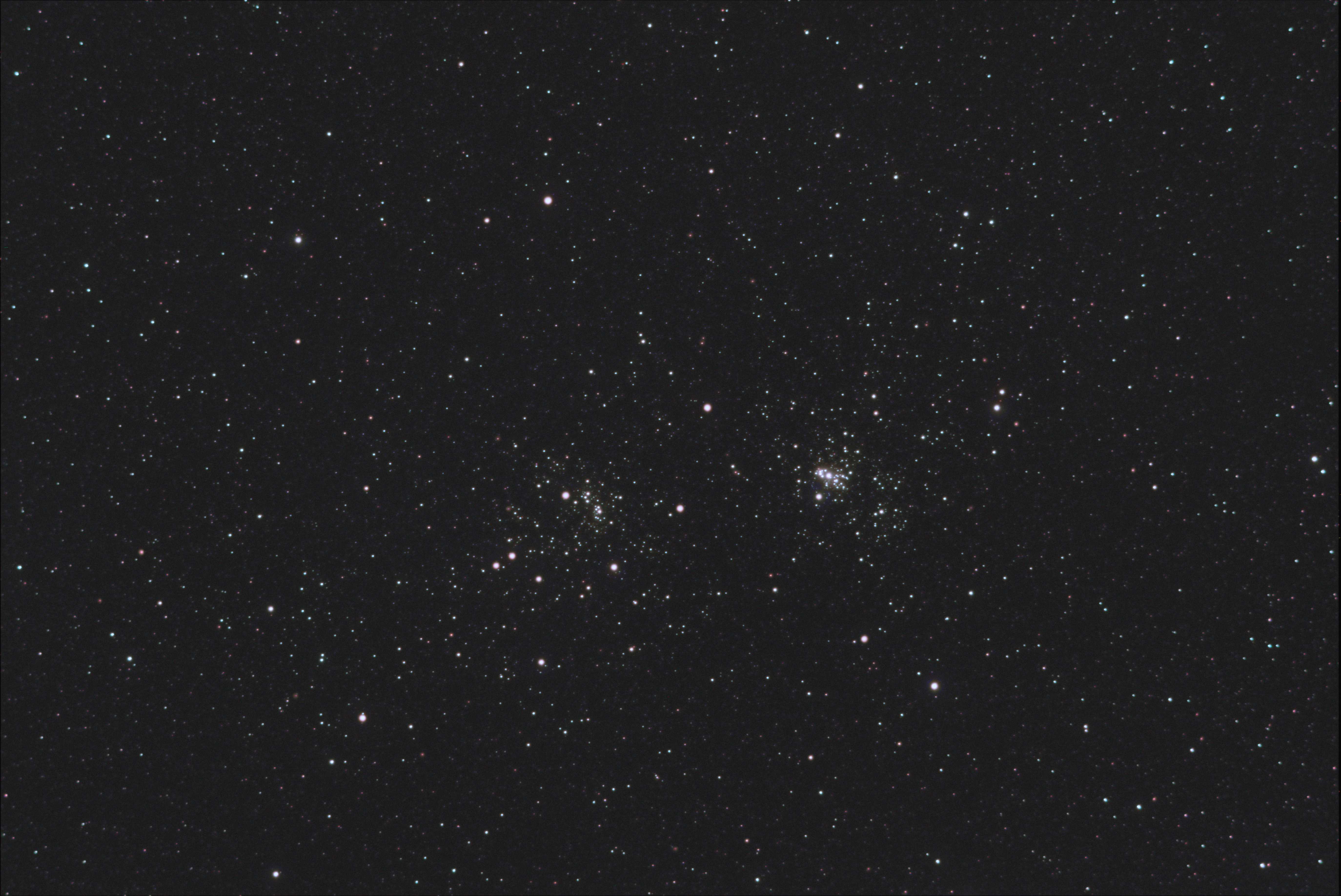
The Double Cluster
The Double Cluster, also known as Caldwell 14, consists of the open clusters
NGC 869 and NGC 884 (often designated h Persei and χ (chi) Persei, respectively),
which are close together in the constellation Perseus. Both visible to the naked eye,
NGC 869 and NGC 884 lie at a distance of about 7,500 light-years in the Perseus Arm
of the Milky Way galaxy.
There are more than 300 blue-white supergiant stars in each of the clusters. The
clusters are also blueshifted, with NGC 869 approaching Earth at a speed of 39 km/s
(24 mi/s) and NGC 884 approaching at a similar speed of 38 km/s (24 mi/s).
Greek astronomer Hipparchus cataloged the object (a patch of light in Perseus) as
early as 130 BCE. To Bedouin Arabs the cluster marked the tail of the smaller of
two fish they visualized in this area, and it was shown on illustrations in
Abd al-Rahman al-Sufi's Book of Fixed Stars. However, the true nature of the
Double Cluster was not discovered until the invention of the telescope, many
centuries later. In the early 19th century William Herschel was the first to
recognize the object as two separate clusters. The Double Cluster is not included
in Messier's catalog, but is included in the Caldwell catalogue of popular deep-sky
objects.
Equipment:
OTA: SVBONY SV503 70ED 70mm Refractor f/6
Reducer: SVBONY SV193 0.8x reducer f/4.8
Filter: SVBONY CLS City Light Suppression filter
Camera: ZWO ASI183MC Pro Cooled Color Camera (20.1 mp)
Mount: Explore Scientific EX02GT with PMC8
10x30s subs (5 minutes) stacked in SharpCap 4.1 with darks & flats
Processed with GraXpert, Topaz AI Denoise, and Siril.