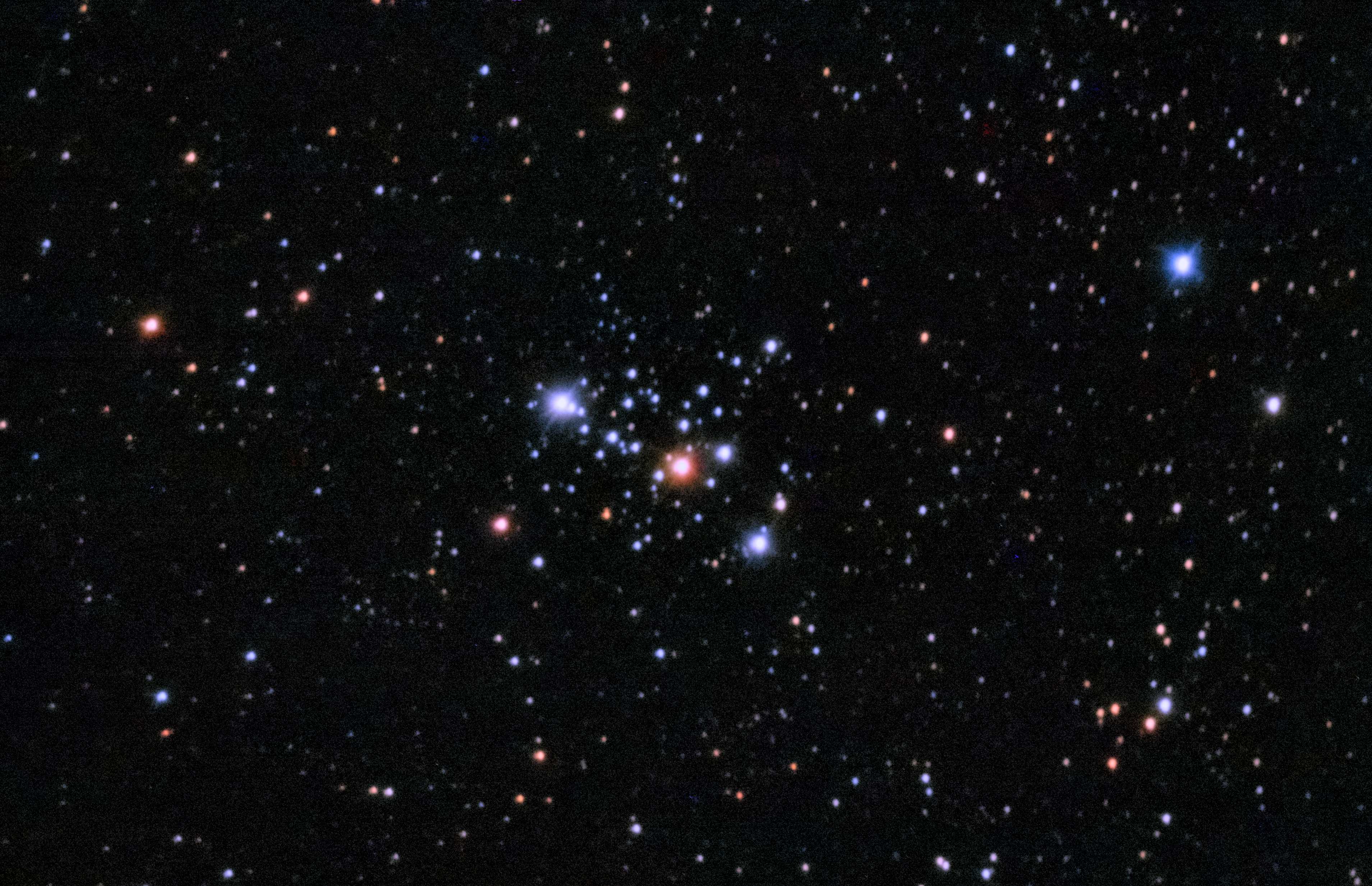
Messier 103 - Open Cluster
Messier 103 (also as NGC 581) is a small open cluster of many faint stars
in Cassiopeia. It was discovered on 27 March 1781 by Pierre Méchain, but
later added as Charles Messier's last deep-sky object in his catalogue.
It is located 9,400 light-years from Earth and is about 15 light years across.
It holds two prominent stars, of which the brightest is magnitude 10.5, and in
the center of the cluster, another magnitude 10.8 red giant. Another bright
foreground object is the double star Struve 131, but is not a member of the
cluster. Cluster membership is about 172 stars based on >50% probability of
gravitational attachment that binds the cluster together. Messier 103 is
between 12.6 million to 25 million years in age.
After the discovery of Messier 101 through 103 by Pierre Méchain, Messier later
added this open cluster to his own catalogue. In 1783, William Herschel described
the region of MESSIER 103 as 14 to 16 pretty large stars and with great many
extremely faint ones. Åke Wallenquist first identified 40 stars in Messier 103
while Antonín Bečvář raised this to 60. Archinal and Hynes suggest that the
cluster has 172 stars. Admiral William Henry Smyth pointed out the cluster's
10.8-magnitude red giant, citing it was a double star on Cassiopeia's knee,
about 1° northeast of Delta Cassiopeiae, sometimes called as Ruchbah or Rukhbah.
Equipment:
OTA: Apertura 6" Ritchey-Chretien Reflector (f/9)
Reducer: Astro-Physics CCDT67 0.67x Reducer (f/6 overall)
Filter: SVBONY CLS City-Light-Suppression Filter
Camera: ZWO ASI183MC Pro Cooled Color Camera (20.1 mp)
Guide Scope: SVBONY SV106 50mm f/3.8
Guide Camera: ZWO ASI120MM Mini Guide Camera
5x60s subs (5 minutes) stacked in SharpCap 4.1 with dark & flats
Processed with GraXpert, Topaz DeNoise AI, and Siril.