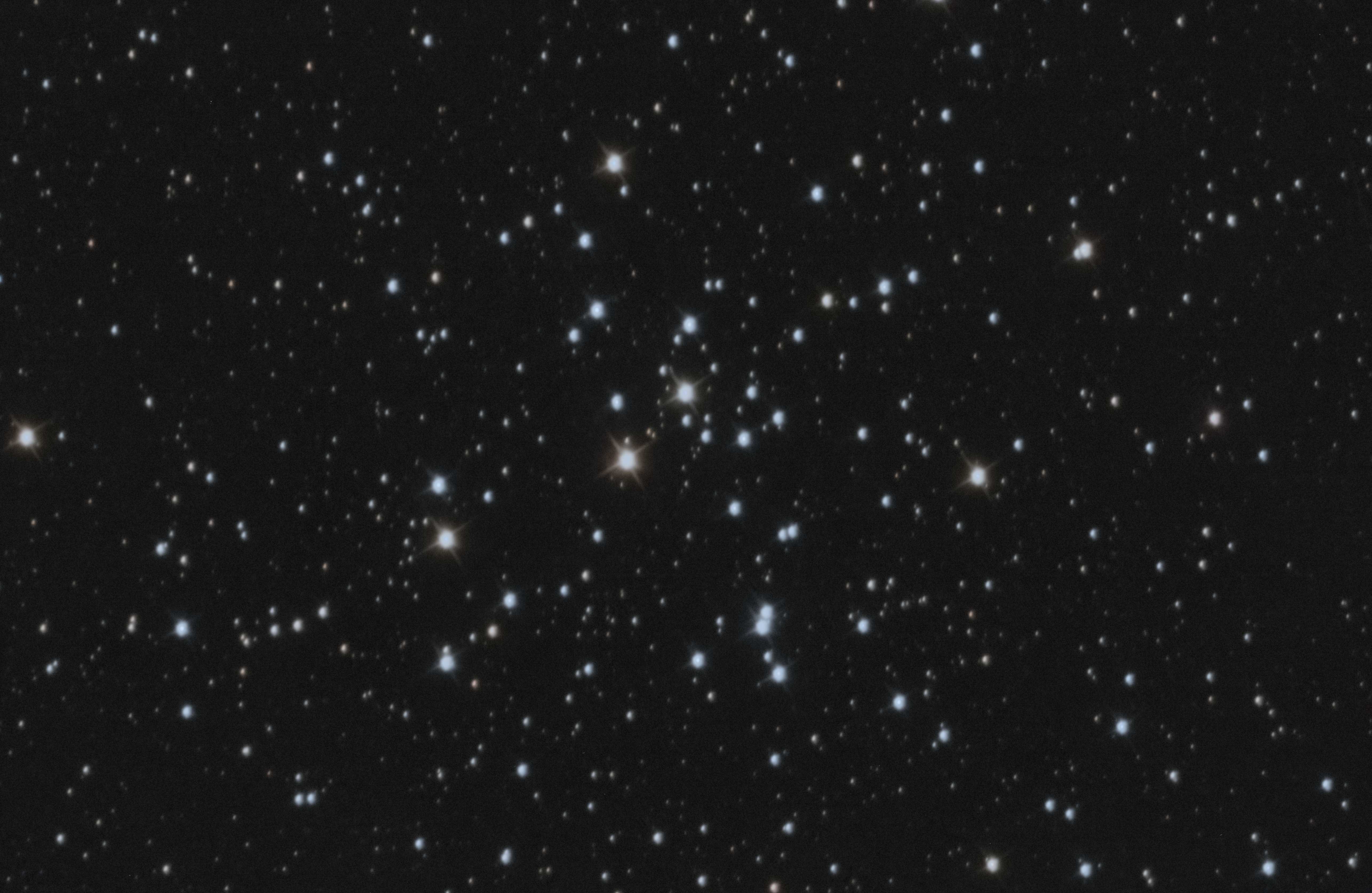
Messier 41 - The Little Beehive Cluster
Messier 41, also known as NGC 2287, is an open cluster in the constellation
Canis Major. Discovered by Giovanni Batista Hodierna before 1654, Messier 41 may
have been observed by Aristotle as early as 325 BC. It is sometimes called the
Little Beehive Cluster due to its resemblance to the Beehive Cluster (Messier 44)
Located approximately just south of Sirius, it forms a roughly equilateral triangle
with Sirius and Nu2 Canis Majoris, visible together in binoculars.
The cluster spans an area comparable to the size of the full moon and contains
about 100 stars, including several red giants and white dwarfs. The cluster
has a diameter of 25–26 light-years. It is about 2,360 light-years from Earth.
Equipment:
OTA: Apertura 6" Ritchey-Chretien Reflector (f/9)
Reducer: Astro-Physics CCDT67 0.67x Reducer (f/6 overall)
Filter: SVBONY CLS City-Light-Suppression Filter
Camera: ZWO ASI183MC Pro Cooled Color Camera (20.1 mp)
Guide Scope: SVBONY SV106 50mm f/3.8
Guide Camera: ZWO ASI120MM Mini Guide camera
60x30s subs (30 minutes) stacked in SharpCap 4.1 with dark & flats
Processed in GraXpert, Topaz Denoise AI, Astrosharp, and Siril.