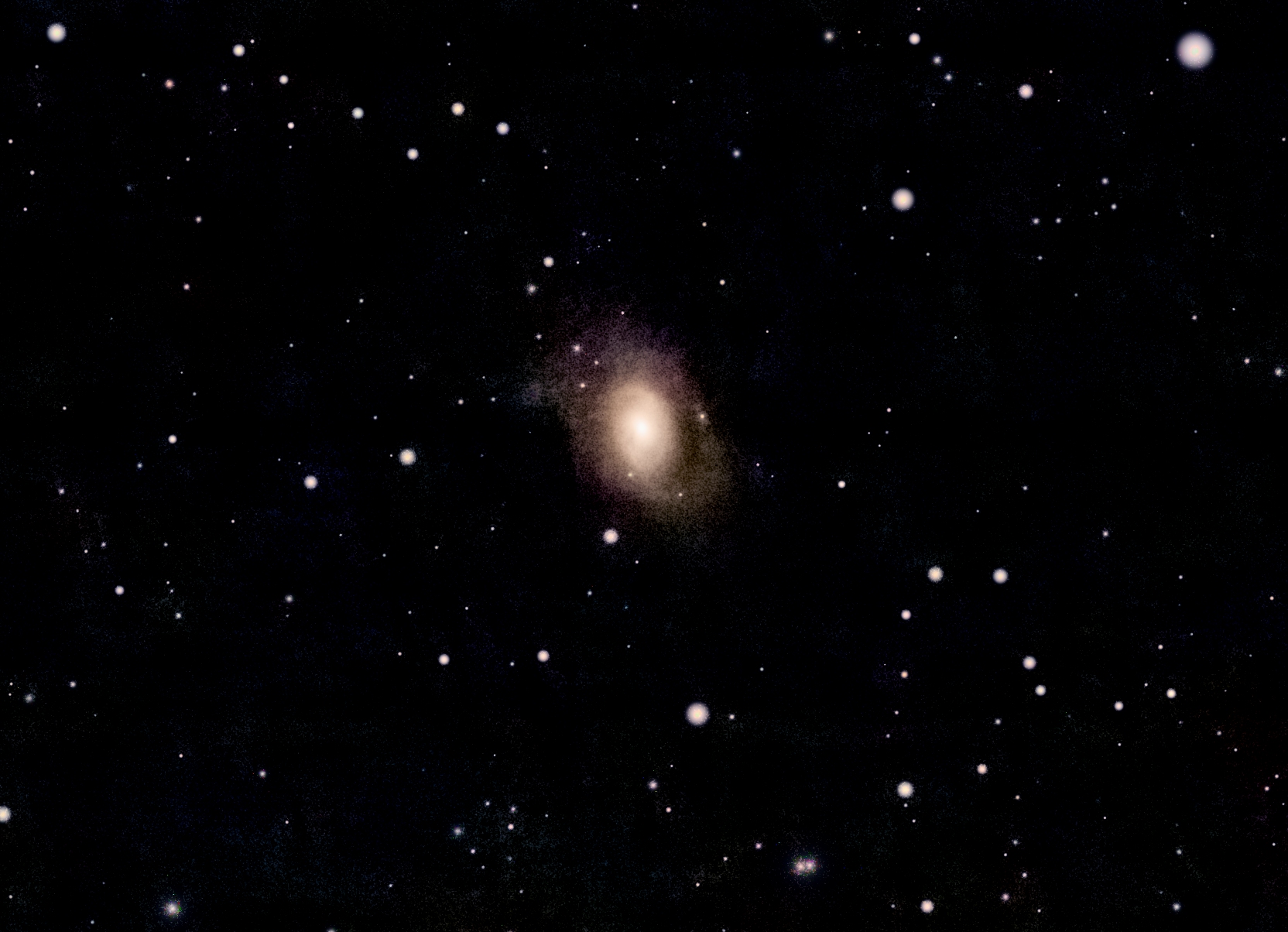
Messier 96 - Spiral Galaxy
Messier 96, also known as NGC 3368, is an intermediate spiral galaxy about
31 million light-years away from Earth in the constellation Leo. Messier 96
was discovered by French astronomer Pierre Méchain on March 20, 1781. After
communicating his finding, French astronomer Charles Messier confirmed the
finding four days later and added it to his catalogue of nebulous objects.
This complex galaxy is inclined by an angle of about 53° to the line of sight
from the Earth, which is oriented at a position angle of 172°.
It is categorized as a double-barred spiral galaxy with a small inner bulge
through the core along with an outer bulge. Variations in ultraviolet emission
from the core suggest the presence of a supermassive black hole. Estimates
for the mass of this object range from 1.5 million to 48 million solar masses.
Messier 96 is about the same mass and size as the Milky Way. It is a very
asymmetric galaxy; its dust and gas are unevenly spread throughout its weak
spiral arms, and its core is just offset from the midpoint of its extremes.
Its arms are also asymmetrical, thought to have been influenced by the
gravitational pull of other galaxies within the Messier 96 galaxy group.
The other Messier objects in this group are Messier 95 and Messier 105.
Equipment:
OTA: SVBONY SV503 70ED 70mm Refractor f/6
Reducer: SVBONY SV193 0.8x reducer f/4.8
Filter: SVBONY CLS City Light Suppression filter
Camera: ZWO ASI183MC Pro Cooled Color Camera (20.1 mp)
Mount: Explore Scientific EX02GT with PMC8
120x30s subs (1 hour) stacked in SharpCap 4.1 with darks & flats
Processed with GraXpert, Topaz AI Denoise, and Siril.