Deep Sky Objects
These are my photos of star clusters, nebulae, and galaxies that are either not in the Messier Catalog or are part of a group of objects.
Most are are refered to by their common names, a New General Catalog Number (NGC), or other astronomical designation.
They are grouped into four distinct groups. Nebulae, Galaxies, Open Clusters and Globular Clusters.
Nebulae
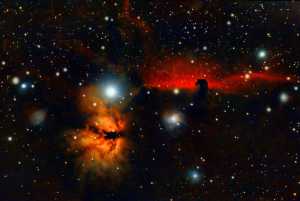
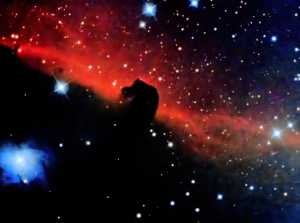
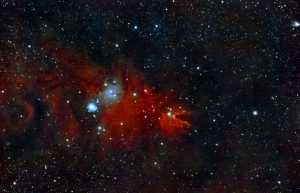
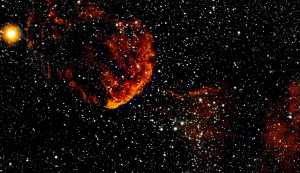
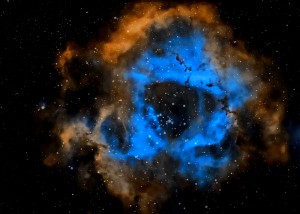
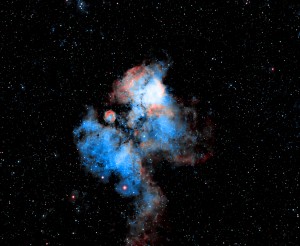
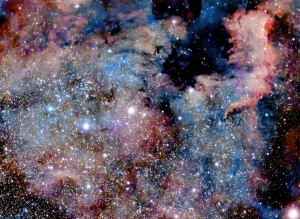
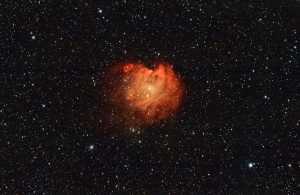
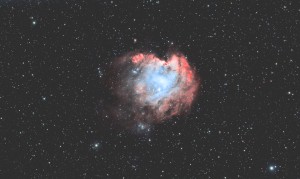
Nebulae have been characterized in to several types: Emmission Nebulae, Reflection Nebulae, and Dark Nebulae.
Emission nebulae are glowing clouds of ionized gas, primarily hydrogen, that emit their own light when energized by nearby hot, young stars or dying stars, acting as stellar nurseries where new stars form and influencing galactic structure by shaping gas and dust. They are identified by their characteristic colors, especially the red from hydrogen-alpha (H-alpha) and green/blue from oxygen, and include types like H II regions (star-forming) and planetary nebulae (dying stars).
Reflection nebulae are visiable because the gas and dust theyt contain reflects the light of nearby stars.
Dark nebulae are dark or opaque clouds of gas and dust that obscure the light of stars or objects behind them.
Many nebulae are comprised of a combination of the above types.
Galaxies
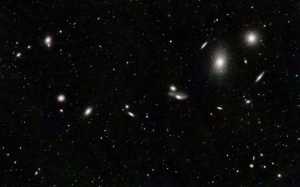
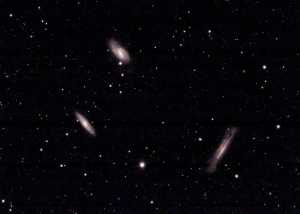
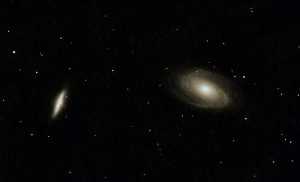
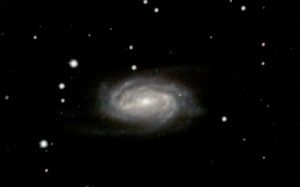
A galaxy is a system of stars, stellar remnants, interstellar gas, dust, and dark matter bound together by gravity. The word is derived from the Greek galaxias, literally 'milky', a reference to the Milky Way galaxy that contains the Solar System. Galaxies, averaging an estimated 100 million stars, range in size from dwarfs with less than a thousand stars, to the largest galaxies known – supergiants with one hundred trillion stars, each orbiting its galaxy's centre of mass.
Open Clusters
Open Clusters
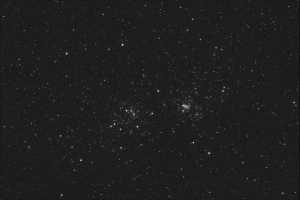
An open cluster is a loose, gravitationally bound group of tens to a few thousand young stars that formed together from the same gas cloud, found primarily in the spiral arms of galaxies like the Milky Way, and eventually disperse due to galactic interactions over millions to a few billion years. Key examples include the Pleiades (Messier 45) and the Double Cluster (NGC 869/884), and they serve as important "laboratories" for studying stellar evolution because their stars share similar ages and compositions.
Globular Clusters
Globular Clusters
